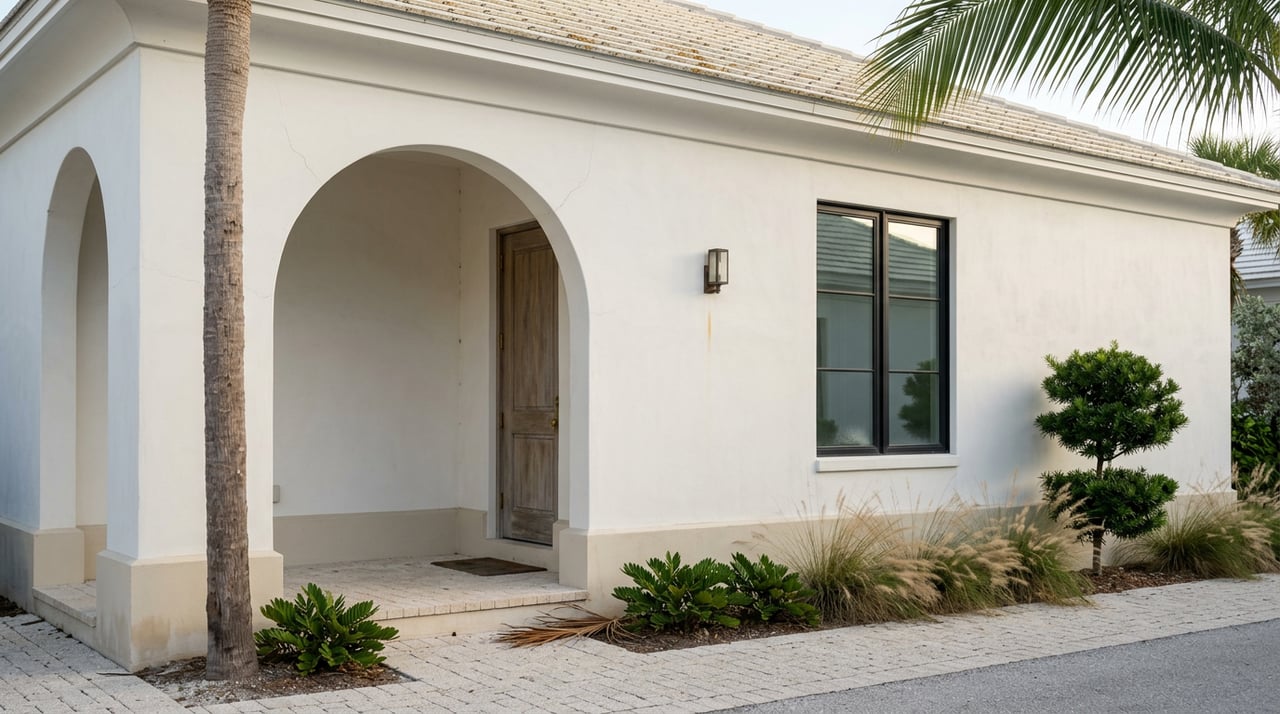
A homeowner who wants to repaint a front door in Rosemary Beach cannot just buy a can of paint and start rolling. Even repainting it the exact same color requires a submittal to the town's Architectural Review Board, complete with drawings from a licensed design professional. Windows, siding, roofing, fences, landscaping, and paint all move through the same process, regardless of how small the project is.
Buyers pricing a home here tend to stop their math at the purchase price and the monthly HOA due. That's the wrong endpoint. Rosemary Beach's design code turns nearly any exterior change into a governed, fee-bearing event, and the closing table carries a separate bill that has nothing to do with whether the new owner ever touches a wall. The two costs stack, and neither shows up in a listing description.
The Pattern Book Is Enforced, Not Decorative
Rosemary Beach was master-planned by Andres Duany and Elizabeth Plater-Zyberk, architects associated with the New Urbanism movement, and their plan didn't stop at street layout. It extends into a governing document known as the Pattern Book, which controls window proportions, paver materials, siding, roofing, and paint colors down to the swatch. Construction is limited to twelve predefined building types. None of it happened by accident, and none of it is optional for an owner who wants to make a change.
The town backs this with paid staff, not just paperwork. Earlier this year, the Rosemary Beach Property Owners Association circulated a request for proposal for a part-time Town Architect, on site one day a week for roughly four to eight hours, with the remaining work handled remotely under a monthly retainer. That's an ongoing, funded design-review function, the kind of infrastructure you'd expect from a municipal planning office, layered onto a private residential community.
What Review Actually Costs, in Dollars and Months
The Architectural Review Board meets monthly, and every submittal needs drawings from a licensed design professional, which means the fee clock starts before a contractor ever picks up a tool. A simple project, replacing a door or adding window boxes, typically runs $500 to $1,500 in architectural fees before construction begins. A major renovation requiring engineered drawings can accumulate $15,000 to $35,000 in design and compliance costs alone.
Timeline is the cost buyers underestimate most. The board commonly requests revisions, and each round can add 60 to 90 days to a project that would move faster almost anywhere else on 30A. For an owner carrying a construction loan or renting elsewhere during the work, that delay has a real dollar value even though it never appears on an invoice.
Contractors price this in. Rates for tradespeople working in Rosemary Beach typically run 20 to 30 percent above what the same work costs in surrounding communities, driven by narrow alleys and limited parking that slow every job, the extra time required to work through ARB documentation, and a summer season when contractors prioritize larger commercial projects over small residential ones. Builders who work here regularly, among them Big Sun Development, Envision Builders Group, Corestruction, and Magnolia Custom Homes, have built their process around this reality. A buyer who assumes any local contractor can quote a Rosemary Beach job the way they'd quote one in a neighboring town is working from the wrong baseline.
The Bill That Arrives Whether You Renovate or Not
Separate from anything a renovation might cost, buying into Rosemary Beach carries charges that apply the moment the deed changes hands. A buyer pays a one-time transfer fee equal to 1 percent of the purchase price at closing, which comes to $20,000 on a $2 million sale. New construction or a major renovation adds a capital contribution fee on top, ranging from $5,000 to $25,000 depending on project scope. HOA dues for single-family homes generally run $400 to $800 a month.
None of that includes insurance or upkeep. Standard homeowners insurance doesn't cover wind damage in coastal Zone A, so owners carry layered wind and flood policies, and salt air drives maintenance reserves a mainland home wouldn't need. Add it up and a $1.5 million to $2.5 million property in Rosemary Beach carries roughly $31,800 to $59,600 a year beyond the mortgage, before a single renovation decision gets made.
| Cost category | Typical range |
|---|---|
| HOA dues, single-family | $400-$800/month |
| Transfer fee, buyer-paid, one-time | 1% of purchase price |
| Capital contribution fee, new construction or major renovation | $5,000-$25,000 one-time |
| Layered wind and flood insurance | $12,000-$25,000/year |
| Deferred maintenance reserve, salt air | $15,000-$25,000/year |
| Total annual carrying cost beyond mortgage, $1.5M-$2.5M property | $31,800-$59,600/year |
Why the Premium Holds
None of this reads as a design flaw once you consider what it protects. Rosemary Beach's homes are finished largely in stucco over true masonry, and that construction method costs 30 to 40 percent more than the wood-frame synthetic stucco common in conventional Florida developments. The town chose the more expensive material, then built a review process to keep it consistent, because the uniformity is the product. Every fee, every 60-day revision cycle, every dollar paid at closing is part of the same system that keeps the streetscape from drifting toward whatever any single owner might otherwise choose.
The costs aren't hidden from the town. They're the mechanism. A buyer who understands that going in can budget for it instead of discovering it mid-project.
If the Plan Includes Renting It Out
Many buyers weighing a renovation are also weighing rental income, which adds a third layer of compliance on top of the ARB and the HOA. Rosemary Beach sits in unincorporated South Walton, where the county requires a Short-Term Vacation Rental Certificate, a designated local Responsible Party who can respond within one hour, posted in-home signage, and an Affidavit of Compliance. The HOA layers its own rules on top of that: minimum stays of seven nights during summer peak season, three to five nights off-season, and occupancy caps enforced with fines of $500 to $1,000 per violation.
The seasonal squeeze cuts both ways. Spots like Pescado Seafood Grill & Rooftop Bar and Restaurant Paradis become nearly impossible to walk into between Memorial Day and Labor Day, and the same crowding that fills tables also fills contractor schedules. An owner planning a renovation around a summer rental gap should expect the same tradespeople who'd normally take the job to be busy on larger commercial work instead.
Before You Write an Offer
- Ask for the current ARB fee schedule and any recent approval timelines for a comparable project.
- Confirm whether the property's exterior finish is masonry stucco or an alternate material, since that changes both maintenance cost and any future ARB submittal.
- Get the HOA's current transfer fee and capital contribution fee in writing rather than estimating from a percentage alone.
- If rental income is part of the plan, confirm the property's current Short-Term Vacation Rental Certificate status with Walton County before assuming it transfers cleanly.
- Ask a builder who already works in Rosemary Beach for a quote rather than one who has never worked through the ARB process here.
A Few Questions Worth Answering First
Does the ARB review interior work too? No. The board's authority covers exterior modifications, so interior renovations that don't change the building's exterior appearance generally fall outside its process, though structural work may still require standard county permitting.
Can I avoid the capital contribution fee by buying a home that's already renovated? Sometimes. The fee is typically triggered by new construction or major renovation, so a home already updated by a previous owner may not carry the same one-time charge, though the transfer fee still applies to every sale regardless of the property's condition.
Ready to Talk Through the Numbers
A Rosemary Beach purchase is as much a decision about governance as it is about square footage. Understanding what the Pattern Book requires, what the ARB costs in time and dollars, and what shows up at the closing table gives you a real budget instead of a guess. Joshua Fowler can walk through the specifics for a property you're considering, from the transfer fee math to which local builders already know the process. Let's Connect.