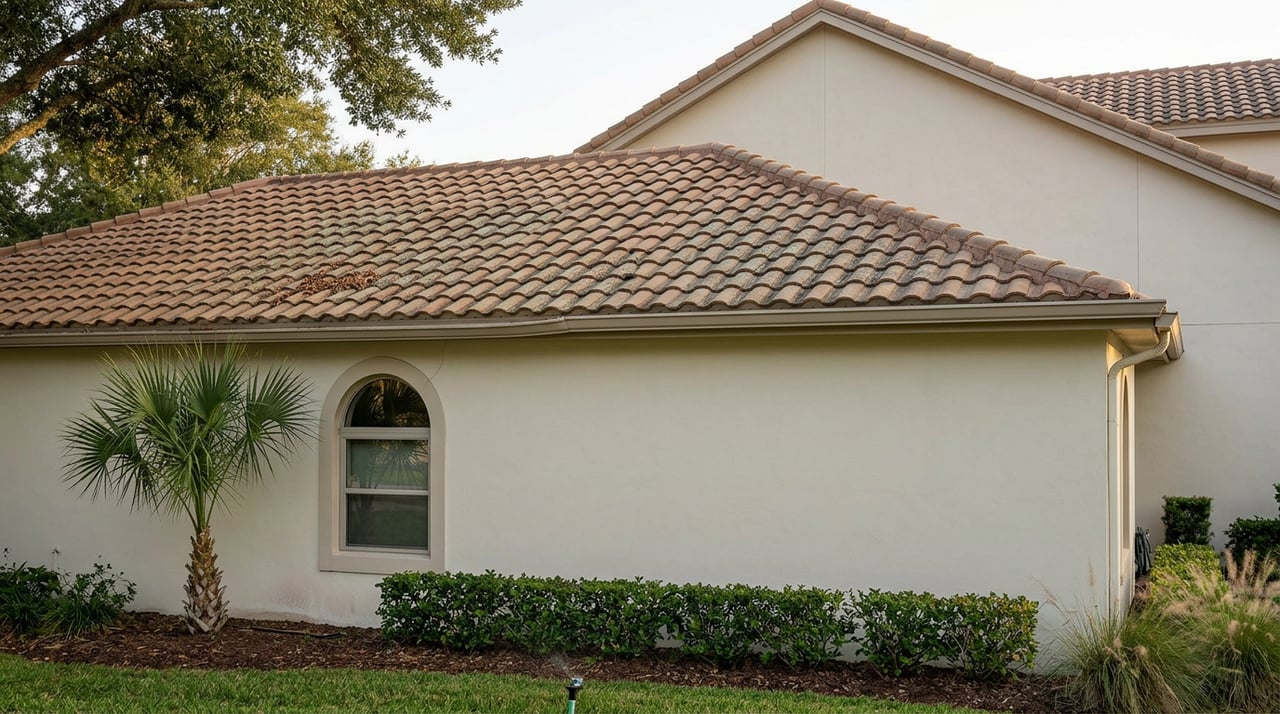
Walk two blocks in The Cove and you'll pass bungalows built within a few years of each other, similar square footage, similar asking price, similar oak canopy overhead. Ask an insurance underwriter about either one and you might get two completely different answers. The split has nothing to do with the decade stamped on the tax record. It has to do with a storm that came through Bay County in October 2018, and whether a given roof was fully torn off and replaced afterward or simply patched and left alone.
That distinction is quietly becoming the first real hurdle in a Cove transaction, ahead of price, ahead of inspection contingencies, sometimes ahead of the offer itself. Here's the mechanism behind it, and what it means if you're buying or selling one of the neighborhood's mid-century homes in 2026.
The Question That Actually Decides Your Rate
Florida law sets a floor: an insurer cannot refuse to issue or renew a homeowners policy solely because a roof is under 15 years old. Cross that line, though, and the calculus changes. Once a roof passes 15 years, the insurer can require an inspection, and if that inspection confirms at least five years of remaining useful life, the insurer still can't decline coverage on age alone. If it doesn't, you're looking at a repair demand, a shift to actual cash value coverage, or a non-renewal notice.
The detail that trips people up is how "age" gets calculated. It isn't measured from when the house was built. It's measured from the date of the last full, permitted roof replacement. A partial repair after storm damage doesn't reset that clock. If three-quarters of your roof got new shingles after a bad season but the rest didn't, the roof's insurance age is still tied to whatever was there before the repair.
Citizens Draws a Harder Line at 25 and 50
For homes that end up with Citizens Property Insurance Corporation, Florida's insurer of last resort, the thresholds are published and specific. Citizens requires documentation of a full roof replacement for shingle roofs older than 25 years and for tile, slate, clay, concrete, or metal roofs older than 50 years, unless the homeowner can submit documentation showing at least five years of remaining useful life. Many private carriers apply similar scrutiny well before that, often triggering a four-point inspection once a dwelling passes 20 years old regardless of what the roof itself looks like.
None of this is unique to The Cove. What's unique is how unevenly it lands on a neighborhood built almost entirely of homes old enough to hit every one of these thresholds at once.
The Storm That Drew the Line Through the Neighborhood
Hurricane Michael made landfall near Panama City in October 2018 as one of the strongest storms to hit the Florida Panhandle in decades, and the roof damage across Bay County was widespread enough that entire blocks went through insurance claims and reroofing within the same one or two years. For homes in The Cove that took qualifying damage and went through a full tear-off and replacement, that means a roof dated 2018 or 2019, which puts it at seven or eight years old today. That's comfortably under the statutory floor and nowhere near Citizens' documentation triggers.
But not every roof in the neighborhood got that reset. Some homes sustained damage that got patched rather than fully replaced. Others simply weren't damaged enough to justify a claim, which meant whatever roof was already on the house, sometimes already 15 or 20 years old before Michael ever formed in the Gulf, just kept aging in place. Those roofs are now well past 25 years, sitting squarely inside the range where Citizens wants a full replacement or a documented remaining-life certification before it will write or renew a policy.
That's the actual dividing line running through The Cove's housing stock. It isn't 1950s versus 1960s construction. It's whether a given roof went through a full, permitted replacement in the Michael era or quietly aged past it. Two bungalows built the same year, listed a few thousand dollars apart, can produce entirely different underwriting conversations because of a repair decision made almost a decade ago that shows up nowhere on the listing sheet.
What Changed for 2026, and What Didn't
Two bills that would have expanded roof-age protections to all residential property insurance policies, not just standard homeowners policies, died in committee in March 2026. If you've heard that broader protections are now in place, that's not accurate. The rules governing roof age in Florida right now are still the ones from the 2022 and 2023 reforms: the 15-year floor, the five-year remaining-life inspection standard, and Citizens' published age caps.
What has changed is the price of coverage itself. Citizens filed for an average rate reduction of roughly 8.8 percent on multiperil policies and about 5.5 percent on wind-only policies, effective for policies with a July 1, 2026 renewal date. That narrows, but doesn't erase, the gap between insuring a home with a documented recent roof and one that's about to trigger a four-point inspection.
Two Roof Profiles, Two Very Different Closings
| Reroofed after Michael (2018-19) | Roof untouched or only patched since before Michael | |
|---|---|---|
| Insurance age in 2026 | Roughly 7 to 8 years | Often 25 years or older |
| Statutory floor | Well under the 15-year threshold | Past it, inspection required |
| Citizens documentation | Typically not triggered | Full replacement or remaining-life certification required |
| Effect on closing | Rarely becomes a negotiating point | Often shows up as a seller credit or a pre-closing reroof condition |
What to Pull Together Before You List or Write an Offer
If you're on either side of a Cove transaction this year, the paperwork that matters most isn't the listing photos. It's the roof's documented history.
- The Bay County building permit record for any reroof, which confirms date and scope of the work
- The contractor invoice showing whether the job was a full tear-off or a partial repair
- Any existing four-point or wind mitigation inspection report, since a recent one can save weeks in underwriting
- A remaining-useful-life certification if the roof is already past the relevant threshold, since that document is what keeps a policy from being declined on age alone
Sellers who gather this before listing tend to avoid a surprise mid-contract. Buyers who ask for it before writing an offer get a much clearer read on what their actual monthly cost of ownership looks like, not just the number on the purchase contract.
A Few Questions Worth Asking First
Does a partial reroof after a storm reset the age for insurance purposes? No. Insurers count from the date of a full, permitted replacement. A patch job, even a large one, doesn't start a new clock.
If my Cove bungalow's roof hasn't been touched since before Michael, does that mean I can't get coverage? Not automatically. Florida law lets you obtain an independent inspection, and if it documents at least five years of remaining useful life, an insurer can't refuse coverage on age alone. You'll need that documentation in hand, not just an assumption that the roof still looks fine.
Is there a new 2026 law that changes any of this? No. The bills that would have expanded these protections died in committee in March 2026. The framework in place is still the one from the 2022 and 2023 reforms described above.
If you're weighing a purchase or a sale in The Cove and want a clear-eyed read on what a specific roof's history means for your timeline, Joshua Fowler can walk through it with you. Let's connect.